|
Net Loss: Internet Profits, Private Profits and the Costs to Community
My Writing
Populist Columns
The Nation American Prospect NetAction Work Other Tech Writing Academic Articles Election 2000 & After Older Political Writing
Special Topic Pages
|
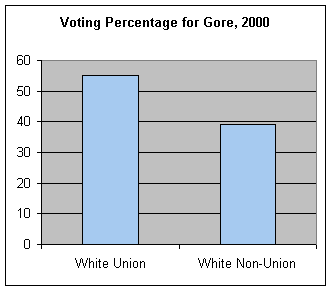
Progressive Populist by Nathan Newman November 15, 2003 Unions dramatically increase the progressive voting patterns of workers. This basic fact is confirmed by this study from the Annenberg National Election Survey which interviewed 58,373 adults in the course of the 2000 election season. The headline is that union households supported Gore over Bush by a 58% to 36% margin, while non-union households went only 44% for Gore while giving 51% of their votes to Bush. Even more dramatically, 63% of voters in union households supported Gore in 16 "Battleground States" that largely decided the 2000 election, while only 44% of voters in non-union households supported Gore. Without union households, Bush would have won the most votes in the election, period. And for all the "moderates" who worry about appealing to white voters, the reality is that white union households voted by strong majorities for Gore.
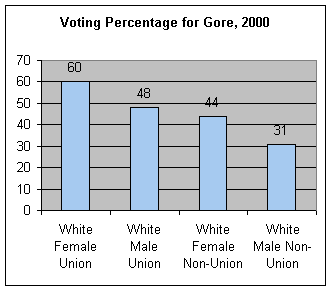
These numbers are even more interesting when broken out by sex. You can see that despite the gender gap, white male unionists vote more strongly Democratic than females in non-union households.
So expanding unionization is the one almost guaranteed way to expand progressive voting. But one thing people may say is sure, people in unions vote more Democratic, but the minority of Americans who join unions are probably already more liberal. This is always an important statistical caveat -- but the Annenberg study examined the political views of union and non-union households. And here's the most startling result of the survey. Voters in union and non-union households have almost identical views on most issues, with only a tiny marginal liberal tilt in union households. Just look at this table below. Table B -- Opinions on Issues,
How to explain the difference then? One answer is that unions do more outreach to their members, while non-union households have to depend on the regular media. "Between October 1 and Election Day, 7 percent of union household respondents in those states said they had heard from outside organizations, a grouping that includes unions. Four percent of non-union respondents said they had." While small numbers overall in the population, those members contacted by unions were generally in key states (note the higher union margin in Battleground states) and no doubt used that information in talking to co-workers and friends, further influencing voting patterns. When progressives think of the "progressive media", they generally think of The Nation or The American Prospect, but each of those measure their readership in the tens of thousands. But union publications like America@Work, UAW's Solidarity Magazine, and other union publications go out to millions of union members each month. Those publications are the main alternative media reaching progressive voters each day, so it's hardly surprising that it plays a role in encouraging a better informed voting population among union members. The bottom line is that getting people into unions has dramatic effects on their voting patterns, not a few percentage points, but a margin of 16-19% among any demographic group. That is why supporting unionization campaigns should be a top priority of any progressive concerned about electoral results in this country. Posted by Nathan at November 15, 2003 09:10 PM |