|
|
<< Solidarity in Action | Main | Rightwing Seek Overturning of New Deal >> October 31, 2003"Bush Boom"- Bush Booming DebtLike the end of "major combat operations" and Iraq's "imminent threat", conservatives may rue declaring the start of the "Bush Boom." This quarter could easily be a false dawn once again of temporary growth followed by another drop. Given the economic steroids being injected into the economy in the form of low interest rates and massive deficits, it's hard to take seriously celebration over one quarter of growth, especially with the pathetic job creation. If this is all Bush can generate maxxing out the public credit card to inject money into the economy, it means the underlying economy-- without the artificial stimulants -- is truly sad. As Lloyd Bentsen once said of the Reagan "boom", "You know, if you let me write $200 billion worth of hot checks every year, I could give you the illusion of prosperity too." Bush Record Debt Increases: Well Bush is writing a record $371 billion "hot check" for fiscal 2003, with an estimated $480 billion deficit to come in fiscal 2004. Despite this, some Bush defenders will claim that his deficits aren't so bad if you take into account inflation. (Yes, inflation-adjusted numbers make the dollar increase in deficits in Bush years look roughly similar to many Reagan and Bush I deficits.) But the problem with that argument is that it raises the right issue of making comparisons taking account of inflation, but it only does so in regard to the yearly deficit number, without paying attention to the effect of inflation on increases in overall debt each year. They are not the same number. The overall real increase in debt, adjusted for inflation, is the combination of the deficit each year between annual taxes collected and federal spending, COMBINED with how much the value of the existing debt changes due to inflation. Even as deficits increase the debt, inflation cuts the real amount owed on existing debt. For example, if the nominal deficit increases the debt by 10%, but high inflation cuts the real cost of the debt by 10%, the outcome would be no real increase in public debt. You can read here for more but the following graph gives you a long historical view of the real increase in debt. It only goes up to 2000, but the evident fact is that since WWII, the only period of real increase in public debt was the Reagan-Bush I period:
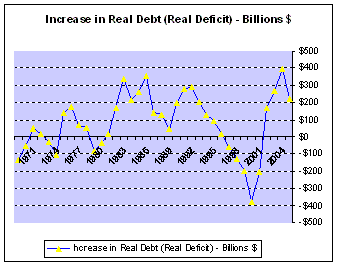
Integrating Bush Junior into the analysis shows that he's continuing that tradition of buying temporary economic stimulus at the cost of massive increases in public debt. Below is a graph showing annual real increases in debt year to year since the start of the Nixon administration:
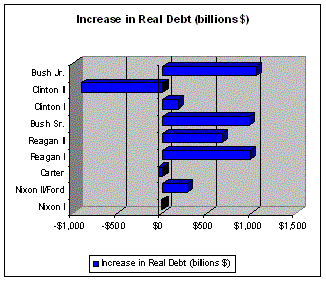
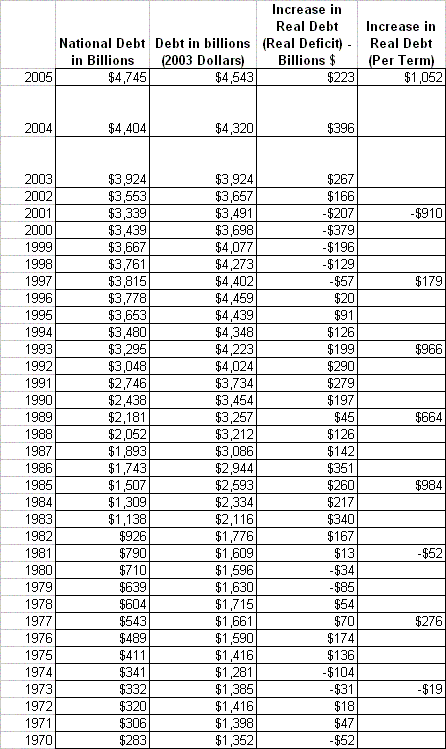
The overall chart explaining the following graphs is at the end of post, but here is a quick summary. If you add up each four-year term, including current estimates for inflation and deficits for Bush through 2005, as calculated by the Congressional Budget Office, you see that the real increase in debt under Bush will be the largest of any four year term:
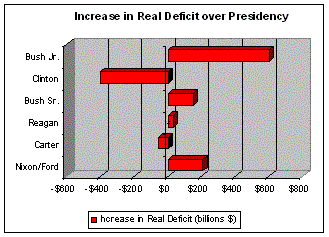
And if you want to measure responsibility-- ie. how much of a situation was inherited and how much of the problem was created in a President's term, just look at much each President added to the annual deficit between the last budget of their predecessor and their final budget (using the estimated Bush 2005 deficit as his final budget):
On this scale, Bush ranks as the most irresponsible, recklessly borrowing President in American history, with essentially no competition. Here is the overall chart of debt held by the public as adjusted to inflation year to year:
Posted by Nathan at October 31, 2003 10:03 AM Related posts:
Trackback PingsTrackBack URL for this entry: Commentsmakes me yearn for the days of the Balanced Budget Amendment. Posted by: Manish at October 31, 2003 12:24 PM Excellent post. But, needless to say, the deficits for the rest of Bush's term are projections and probably will come in worse than projected. (Even if there is an economic pick-up, the lowered tax rates assure that much less of the added national income will show up in government revenues.) On the other hand, if Bush is re-elected... Posted by: john c. halasz at October 31, 2003 01:00 PM This is wonderful info, and I thank you for compiling it. In terms of translating the numbers to a message (where the rubber meets the road in politics), you've written a great sentence we might intone as our mantra over the coming year: "On this scale, Bush ranks as the most irresponsible, recklessly borrowing President in American history." Posted by: Emma at October 31, 2003 01:06 PM Agreed: excellent post! Yeah, democrats need to support some sort of balanced budget amemdment..or at least an almost-balanced budget amendment. I'm sick of cleaning up the messes republicans make. Posted by: Kevin Block-Schwenk at October 31, 2003 01:08 PM One question: is your bottom bar chart in error? It shows Reagan as making a very minor addition to the debt, but the numbers in the extended article, unless I'm adding them wrong, show that Reagan was about as bad as Bush I. Am I missing something? Posted by: Kevin Block-Schwenk at October 31, 2003 01:12 PM John- I'm using CBO, not White House projections on likely deficits. Maybe they'll come in higher, especially if war costs mount, but $480 billion in nominal terms next year is a hell of a lot even if they hit the estimates. The estimate is that deficits will fall significantly by 2005, which should be true if any kind of real growth kicks in-- if we do slide back into recession or even just stagnant growth, the numbers could be far worse. Posted by: Nathan Newman at October 31, 2003 01:12 PM Kevin- "The increase in real deficit over Presidency" chart is kind to Reagan because of the fact that 1989, his last budget, was a very low deficit, $45 billion in real terms. So while Reagan piled up massive debt in his eight years, he managed to leave with a relatively low yearly real deficit. This actually highlights why you have to keep your eye on both real deficits and real debt; they tell slightly different stories and you need both to keep track of the real effect of policies on economic and budgetary health. But obviously Bush Junior is making a hash of the budget by either measure. Posted by: Nathan Newman at October 31, 2003 01:23 PM Have you considered including debt service (interest payments on the debt) as part of an analysis? Bill Clinton balanced the budget and payed over 15% of budget each year to cover the interest on the debt rung up by Reagan and Bush. The interest costs are a huge drag on the next president in office. If one subtracts the interest payments from 1993 to 2001, total revenue exceeded other spending during the Clinton years. One could argue that the only reason any Clinton budgets were in deficit was due to interest payments. A couple of points. I notice that deficits numbers have Social Security on budget. In calculating the true debt, the amount the federal government owes to SS and is earmarked for SS spending needs to be counted as part of the debt. This also makes Reagan look better than he was by about $200 billion dollars. Don't forget that Reagan signed the largest increase in SS taxes every. While cutting taxes on the wealthy, the working class got a rather hefty SS tax hike (which by the way, Mr. Bush has given to his wealthy campaign contributors in the form of income tax cuts.) Posted by: jonny bakho at October 31, 2003 02:30 PM Don't these numbers, especially in the first graph, need to be scaled by the size of the Oh, and Bush II comes out even worse in that analysis. Posted by: Eric H at October 31, 2003 03:00 PM What a load of crap. Gee, don't take into account ANYTHING but the president? Hmm, the internet economy didn't effect the debt at all, did it? And the internet collapse and 9/11 didn't hurt it at all either, did it? Nathan is pathetic. And compeltely desperate. The sad part is some of you people actually bought into his crap. Think for yourselves. Don't let biased morons like Nate here just throw big words and graphs at you and get you to believe anything he says. Posted by: quietcool at October 31, 2003 08:37 PM Can anyone name ONE thing that Clinton did to stimulate the economy in the 90s? Just name one thing he did that actually CAUSED the economy. Please. Show me how it was Clinton and not hte internet that led to the boom. (Then explain why Clinton waited until 1995 to do this, since this is when the economy really started taking off. And also explain why he stopped doing it in MArch 2000 which jsut so happens coincidens with the dot com collapse.) Posted by: dusty at October 31, 2003 08:40 PM Thank you, Nathan. That was very informative. If I may quibble about one point: the Posted by: Kyle McCullough at October 31, 2003 08:44 PM Dusty: It's not surprising that it took until 1995 for the economy to really start to improve under Clinton. He submitted his first budget at the end of 1993, and didn't get his major deficit-reduction bill passed until '94. But to answer your question, getting the deficit under control was Clinton's single biggest contribution to the economy--by the time the Republicans gained control of Congress, Federal Spending/GDP was lower than at any time in the Reagan/Bush years and the deficit was lower than the interest on the Reagan/Bush debt. Getting the runaway deficit he inherited from Bush under control restored investor confidence and allowed interest rates to stay low dispite a booming economy. It's a bit like saying that Jack Welch just picked the right time to be at the helm of GE. There's a little bit of truth to it, but only just a little. Posted by: Kyle McCullough at October 31, 2003 09:18 PM Kyle- the "averaging" of deficits through a Presidency is equivalent to just adding up the total debt added-- which you can see in that chart. It's clear that Reagan added a hell of a lot of public debt in his Presidency. But it's not unfair to note that by the end of his Presidency, deficits that had risen were being reduced. This was largely because pressure from Democrats and some responsible GOPers (there were some back then) pushed through a number of tax increases to restore fiscal sanity. Unlike Reagan, Bush is insanely refusing to even discuss new taxes, even down the line, to restore some balance. Posted by: Nathan at October 31, 2003 11:13 PM Two things Clinton did for the economy: Posted by: Skyler at November 2, 2003 12:19 PM "Got the minimum wage raised to put more money in the hands of people who actually spend money rather than "invest". Guess where more spending money leads to?" I don't see the logic here. Invested money circles the economy in the same way money spent at 7-Eleven would. Don't take my word for it: try a thought experiment. Invest in an imaginary company. Regardless of what they do, they'll inevitably need employees, who will be paid this "spending money." Just as importantly, they'll need things like pens, Post-It notes, and photocopiers. It's not as if the wealthy stuff their cash in a mattress, you know. Whether they buy a yacht (built by Joe Schmoe), invest in a company, or just stick their money in the bank, every dollar gets spent, regardless. I'm still stunned at how many people seem to think that economic growth is just about money changing hands. It's not. REAL increases in overall wealth are about innovation, which is highly fueled by -- you guessed it -- investment. Side-note: I don't quite follow the claim the author here seems to be making. Am I right in my understanding: do you regard this GDP spike as some sort of mirage? The sector-by-sector breakdown clearly shows that this jump was not fueled by the government. Posted by: Chris at November 3, 2003 12:28 PM Oh, also: again, correct me if I'm wrong, Nathan, but aren't you using the CBO model when you say that the deficit is set to hit an unnerving $480 billion? If so, doesn't that SAME model then project drops every year after, eventually resulting in another surplus around 2013 (if memory serves)? Posted by: Chris at November 3, 2003 12:31 PM Yes, Chris I'm using the CBO projections, but I frankly don't take any projections more than a year or two out very seriously. We'll see how accurate even the 2004 and 2005 numbers are, but needed to use something, and that was the best bet. Posted by: Nathan Newman at November 3, 2003 01:15 PM Chris: 1)The government gives tax cuts to the wealthy and the wealthy, in turn, buy treasury bonds to help finance the government deficit; how has that added to net spending circulating in the economy? 2)Though technical innovation is the prime source for increasing productivity and thus the real wealth qua standard of living of a society, financial investment by itself does nothing to guarantee that technical innovation will occur, nor that it will occur efficiently. On the one hand, any technical innovation that is really cost-reducing will effectively finance itself through the increased returns it generates, while, on the other hand, increased investment in capital stock of the same quality will simply come against diminishing returns and prove, in the end, futile. But skewing the distribution of income toward the wealthy, without altering the real productive economy, will increase the monetary valorization of capital assets, since such policies amount to lowering the real wage and increasing the returns to capital, ceteris paribus. Think about it: if the returns to capital stock were increased without altering the actual composition of capital stock, would not the market mechanism increase the valorization of capital stock? Posted by: john c. halasz at November 4, 2003 01:12 AM 1) You're polarizing. The tax cuts are not merely for the wealthy, and even if they were, the wealthy are doing more with the cuts than simply rolling them over into treasury bonds. 2) True, investment does not guarantee technical innovation; but without investment you can all-but guarantee that it won't occur. The belief that, long term, investment = innovation, seems to me to be pretty sound. Posted by: Chris at November 5, 2003 12:08 AM "Yes, Chris I'm using the CBO projections, but I frankly don't take any projections more than a year or two out very seriously. We'll see how accurate even the 2004 and 2005 numbers are, but needed to use something, and that was the best bet." Fair enough. But surely you see my concern: your cutoff seems a little convenient. Hell, inaccurate projections could mean the actual numbers are better than expected, too. Let's not forget that the OMB overshot with this year's deficit projection by about $75 billion. This is all completely apart from whether or not the deficit, regardless of size, is really a cause for concern in the first place. Posted by: Chris at November 5, 2003 12:14 AM Chris: Do you acknowledge the constraints and effects of actual quantitative parameters? 1) The largest share of the tax cuts went to the well-to-do. One can discuss the impact of the middle-class tax cuts separately- and in a recession, they are the proper thing to do. But "polarizing"? Did not a significant quantity of the tax cuts for the wealthy figure to end up exactly as indicated? 2)Is there a shortage of investment capital to finance actually effective capital improvements so as to render tax cuts "necessary" for capital investment and, if so, how should they be targeted? To the contrary, there seems to have been a glut of capital improving investment, since we are now facing a situation of rising productivity rates and stagnant employment. Posted by: john c. halasz at November 5, 2003 02:05 AM Post a comment
|
Series-
Social Security
Past Series
Current Weblog
January 04, 2005 January 03, 2005 January 02, 2005 January 01, 2005 ... and Why That's a Good Thing - Judge Richard Posner is guest blogging at Leiter Reports and has a post on why morality has to influence politics... MORE... December 31, 2004 December 30, 2004 December 29, 2004 December 28, 2004 December 24, 2004 December 22, 2004 December 21, 2004 December 20, 2004 December 18, 2004 December 17, 2004 December 16, 2004
Referrers to site
|