|
|
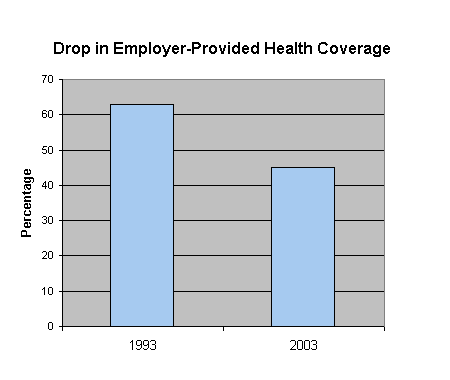
<< "States Rights" Threaten Security | Main | Volokh Gets It Wrong >> September 18, 2003Employer Health Coverage PlummetsHere 's one more reason why California's employer mandate or, better yet, the enactment of a single-payer health care system is so necessary. [BTW WHY AREN"T PROGRESSIVES JUMPING UP AND DOWN WITH FIRST MAJOR STEP FORWARD TO EXPANDING HEALTH CARE COVERAGE IN A DECADE? The California bill has been getting amazingly little discussion in either the media or blog world.] According to a release by the Bureau of Labor Statistics, the proportion of employees receiving health care from employers has plummeted in the last decade, from 63 percent coverage a decade ago down to just 45 percent today. And even when employees are receiving health coverage, their out-of-pocket expenses have soared. Since 1993, the average monthly contribution required of employees has risen 75%. Update: But Amy Phillips in comments and on her site has argued that health care mandates have driven up the costs of health care, so how can a government mandate help the situation. The key is that Amy is talking about mandates for specific benefits, not mandates to provide the health care in the first place. One of the problems of our health care policy is that a lot of the discussion is about "rights" for those with health care already, and not enough about making sure that everyone receives the care in the first place. This is what makes the California law so different. It's a mandate that ALL employers of a certain size provide health care in the first place. And how will that decrease health insurance costs? Because the costs of uncompensated care at many hospitals often get tacked on as surcharges or increased fees for paying customers-- sometimes formally, sometimes informally. Essentially, employers providing health care subsidize the employees of their rival companies who don't provide it. So the new California law will actually be good for the firms that provide health insurance, one reason a majority of companies in California support the new law. Posted by Nathan at September 18, 2003 09:22 AM Related posts:
Trackback PingsTrackBack URL for this entry: CommentsI wrote just recently about the fact that a lot of the increase in cost of coverage is because of government mandates. It is therefore implausible that more government mandates will fix the problem. Posted by: Amy Phillips at September 18, 2003 12:28 PM Crap crappity crap crap! I just looked at the BLS report, and my monthly insurance premium is $220 HIGHER than the average. Meanwhile, I'm making 25% less than the average for my industry. It's time to change regions, I think... crap, I hate moving. :( Posted by: Ab_Normal at September 18, 2003 02:30 PM Perhaps progressives aren't talking about it because they don't care about state issues? I haven't heard much about Maine's universal health care plan, either. http://www.commondreams.org/headlines01/1107-01.htm Posted by: Luke Francl at September 18, 2003 10:43 PM Just a guess....the other crazy things going on in California - the recall, the 9th circuit, and that ballot innitiative, are getting the attention of people talking about California right now, and health care's running behind. Posted by: JoeF at September 18, 2003 11:33 PM The wholesale dropping of employee medical benefits seems to be an upcoming trend. As we traveled across the midwest early this Summer we read about the topic in Omaha, Des Moines and heard a discussion about it in Minnesota. The reasoning was that employers can no longer cover medical benefits for their employees. I couldn't quite understand the twisted reasoning that it would be better for employees if this happened. In our state, auto insurance lobbied to drop no fault insurance so that medical insurance companies supposedly pay the difference. What probably will happen is rates will go up and/or people will be dropped. We already have a health insurance crises for the elderly and people with long term illness. Coverage is either being rescinded or becoming so exhorbitant that people are in crisis situations. I applaud California's attempt. I, also, applaud Illinois attempt to buy cheaper Canadian drugs as an attempt to keep prices down for their state. As a daughter who had to see a parent with a terminal illness worry daily about the price of chemotherapy and whether her secondary health insurance might drop her I can see the system needs to be fixed. The hmo healthcare system is broken. If regions or states could get together as one purchasing agent of healthcare perhaps that would send prices down. It may put a crimp on the influence excerted by hmo lobbyists. Perhaps hospitals and doctors could get back to being able to doing what they are good at; trying to put the patient's health first. I guess what one doctor said, pretty much sums it up for me, "These days doctors have to have an MBA to treat people. That's not what I entered into medicine for." Posted by: cathansen at September 19, 2003 12:59 AM I was at work and in a hurry when I posted the first comment, so let me explain. A big reason that people like you believe that we need mandatory health coverage is that there are many poor people who can't afford to buy coverage because rates are too high. Part of the reason that rates are so high is that federal and various state governments mandate coverage for everything from in vitro fertilization to toupees to inpatient drug rehab. When such services are covered, existing subscribers will use them, raising costs for the insurance company, which then raises rates. Every time this happens, there are thousands of individuals and employers who realize that they can no longer afford insurance, and the ranks of the uninsured balloon. If these poor people were allowed to buy cut rate coverage, they and/or their employers could afford the premiums, and they'd be covered if they got cancer or had an accident (although they may not have coverage for viagra or long term psychological counseling, they're still better off than they would be uninsured). Posted by: Amy Phillips at September 19, 2003 02:45 PM The U.S. Census Bureau's report, "Money Income in the United States, 2001," released last September, contains some interesting data suggesting the weight that employers' health insurance supplements to employees' wage and salary incomes has in affecting the household incomes of the rich and poor. The report is available here.
We shall see if this year's report, when it is released, bolsters the claim that having a job with good health benefits is increasingly a factor in determing which side of the dividing line one falls, as the abyss between the Haves and the Have-nots widens. Posted by: Jamie at September 19, 2003 05:33 PM "In the end, the government just needs to get out of the healthcare business. They need to end the tax system that makes group coverage so much less expensive than individual coverage (tax breaks for company policies, but not for individual policies), get rid of coverage mandates, and let people shop around for the insurance that's right for them. There are, of course, a lot of other problems with our healthcare system, but forcing people to buy coverage they don't really need is never going to fix the problem of exhorbitantly expensive healthcare in this country." There seems to be a peculiar lack of understanding here of what the function of a "pool" is when discussing the concept of insurance. While I don't have much to quibble with on these facts on the ground as described, any solution offered that relies on self-organizing pools is either a deceptive tactic for disenfranchising large chunks of the population from receiving health care at all, or simple innumeracy. It probably doesn't matter which. The complaints are real, but in the end, the only workable solution is going to be single payer. The fact that the cost of an individual policy in a system acceptable to Amy is often infinite for large demographic slices of people will not be tolerated for long. Posted by: Russell L. Carter at September 23, 2003 01:27 PM Is there really only 2 data points over 10 years? Posted by: anonymous at September 23, 2003 11:30 PM Thank you Russell (poster #8), you're absolutely spot on. Single payer is the only workable solution. I read through Amy's comments and they do make sense only if one starts with the premise of trying to make a market based system affordable. But in the end this is a quixotic mission. The fundamental flaw is that health insurance is simply not a rational market -- how can one 'shop around' when you've got a broken limb or cancer? The 'pool' will only work if EVERYONE -- the healthiest to the sickest, the richest to the poorest -- is included. Just like Social Security. The only logical guarantor to provide a baseline floor of coverage and pay the bills is the government. Sadly, the dustbin of well intended ideas on reforming the US health care system is full of failed attempts to make the market based approach work. Posted by: Rob Grocholski at September 24, 2003 02:46 PM the most built-in header. Posted by: rape xxx at September 1, 2004 11:56 AM Post a comment
|
Series-
Social Security
Past Series
Current Weblog
January 04, 2005 January 03, 2005 January 02, 2005 January 01, 2005 ... and Why That's a Good Thing - Judge Richard Posner is guest blogging at Leiter Reports and has a post on why morality has to influence politics... MORE... December 31, 2004 December 30, 2004 December 29, 2004 December 28, 2004 December 24, 2004 December 22, 2004 December 21, 2004 December 20, 2004 December 18, 2004 December 17, 2004 December 16, 2004
Referrers to site
|